
Choosing among the different types of life insurance can feel confusing, especially when policies offer different benefits, costs and coverage periods. Some policies provide protection for a specific number of years, while others can provide lifelong coverage and build cash value.
The right choice depends on your financial responsibilities, budget, family needs and how long you want coverage to last. Understanding the main types of life insurance can help you compare options more confidently before making a decision.
For individuals and families in Florida, including Fort Myers and North Fort Myers, understanding these differences is an important first step toward making an informed coverage decision.
In this guide, we explain how term life, whole life, universal life, variable life and final expense insurance work, how they differ, and what to consider before choosing a policy.
What Are the Different Types of Life Insurance?
Life insurance policies generally fall into two main categories: term life insurance and permanent life insurance.
Term life insurance provides coverage for a specified period. Permanent life insurance is designed to provide coverage for life as long as the policy’s requirements are met. Certain permanent policies also build cash value that may be available to the policyholder under the contract’s terms.
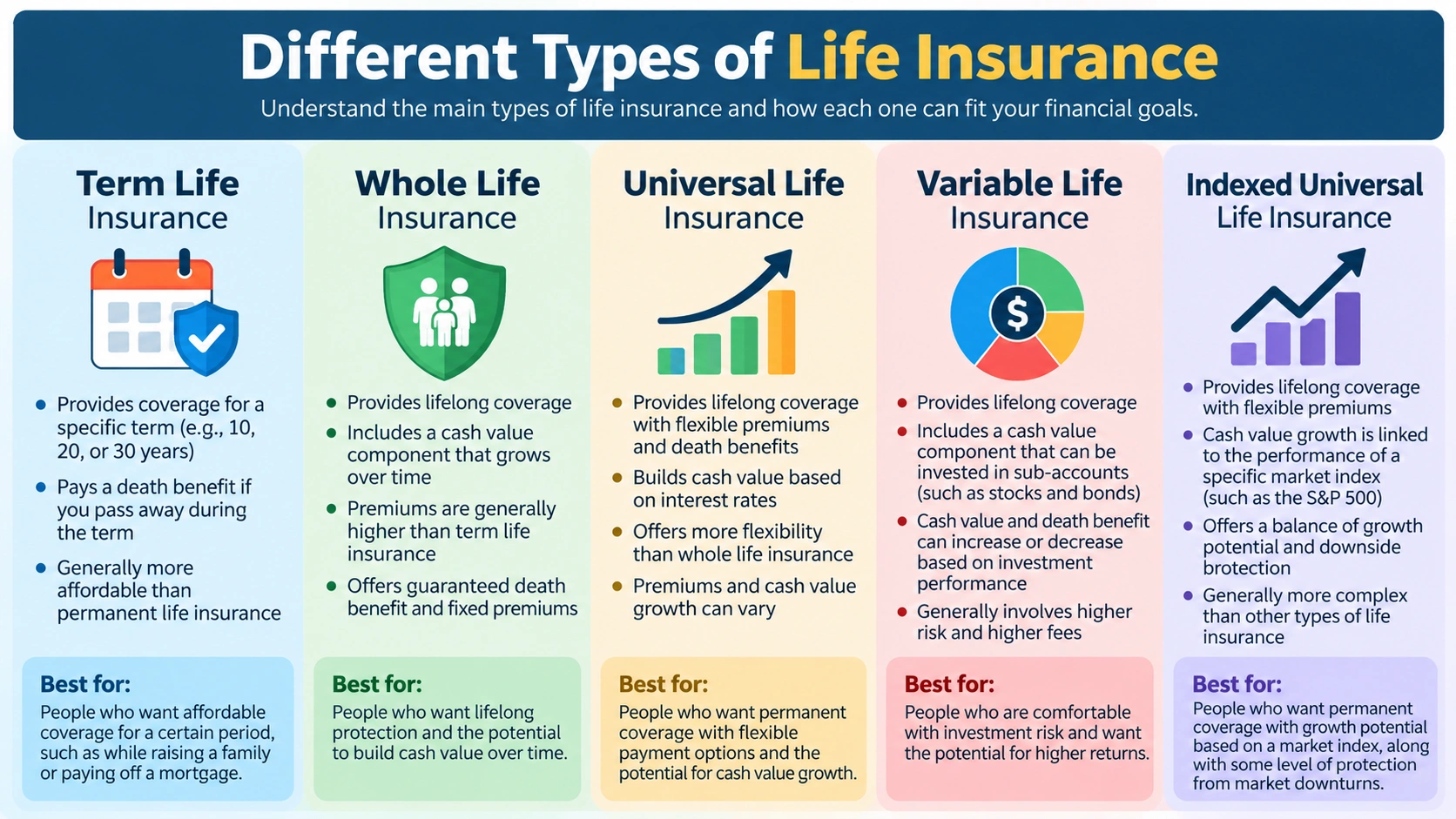
Common types of life insurance include:
- Term life insurance: Provides coverage for a specific period, such as 10, 20 or 30 years.
- Whole life insurance: Offers permanent coverage with contractually defined premiums and cash value features.
- Universal life insurance: Provides permanent coverage with flexible premium and death benefit features, subject to policy requirements.
- Variable life insurance: Combines permanent life insurance with investment options that can affect cash value.
- Final expense insurance: Generally provides a smaller death benefit intended to help beneficiaries pay funeral costs and other final expenses.
Final expense insurance is a type of life insurance marketed for a particular purpose, rather than a separate fundamental category alongside term and permanent insurance.
Each policy works differently. Comparing the features, costs and limitations is essential before deciding which option may suit your needs.
Quick Comparison of Life Insurance Types
| Policy type | Coverage duration | Cash value | Common consideration |
| Term life | A specified term | Generally none | Temporary financial protection |
| Whole life | Designed to last a lifetime | Yes | Predictable contractual features |
| Universal life | Potentially lifelong | Yes | Flexible premiums and ongoing funding needs |
| Variable life | Potentially lifelong | Yes, subject to investment performance | Investment risk and policy complexity |
| Final expense | Depends on the policy | Usually not the main purpose | Funeral and other final expenses |
Actual coverage terms, guarantees, costs and eligibility vary by policy and insurer. Always review the policy documents before purchasing coverage.
1. Term Life Insurance
Term life insurance provides financial protection for a specific period. Depending on the insurer and product, a policy might last 10, 20 or 30 years.
If the insured person dies while the policy is active and the claim meets the contract’s requirements, the insurer pays the death benefit to the named beneficiaries.
Term life insurance generally does not build cash value. Its primary purpose is to provide protection during a period when financial responsibilities may be particularly high.
Who may consider term life insurance?
Term coverage may be worth considering if you:
- Have children or other financial dependents.
- Want to help protect your family while paying a mortgage.
- Need coverage during your working years.
- Want protection while saving for future financial goals.
- Prefer to compare coverage options with lower initial premiums than many permanent policies.
For example, a Florida couple with young children and a 25-year mortgage might consider a 20- or 30-year term policy. The goal could be to provide financial support if one parent dies while the children are still dependent on the household income.
The appropriate coverage amount and term would depend on their income, debts, savings, budget and other existing insurance.
What should you know about term life insurance?
Term policies may offer renewal or conversion options, depending on the contract. Renewing a policy can result in higher premiums, while converting to permanent coverage may involve different costs and conditions.
Check when these options expire, what future premiums may be and whether any restrictions apply.
You should also understand what happens when the original term ends. Coverage may expire, be renewable under the contract or be convertible if the policy provides that option.
Learn more about [Term Life Insurance in Florida] as you compare temporary coverage with permanent alternatives.
2. Whole Life Insurance
Whole life insurance is a type of permanent life insurance designed to remain in force for the insured person’s lifetime, provided the policy requirements are met.
Traditional whole life policies generally offer a defined premium schedule, a stated death benefit and a cash value component. Certain guarantees apply according to the policy contract.
How does whole life insurance work?
Part of the premium helps pay for insurance costs and expenses, while another portion contributes to the policy’s cash value under the contract’s structure.
Cash value generally accumulates over time. The amount and growth depend on the policy’s terms, premiums and any applicable charges or adjustments.
Some whole life policies are participating policies that may pay dividends. However, dividends are not guaranteed unless specifically stated in the contract, and they should not be assumed when comparing projected policy values.
Potential benefits of whole life insurance
Whole life insurance may appeal to people who want:
- Coverage designed to last throughout life.
- A defined premium structure.
- Cash value accumulation.
- A death benefit for their beneficiaries.
- A policy they can maintain over a long period.
However, whole life insurance usually costs more than term insurance for comparable initial death benefits. It is important to assess whether the premiums fit your budget over the long term.
Can you borrow against whole life cash value?
Many whole life policies allow policyholders to borrow against available cash value. Loans generally accrue interest and reduce the policy’s available value and potentially its death benefit if not repaid.
A loan or withdrawal can also affect the policy’s long-term performance. In some circumstances, surrendering or allowing a policy to lapse with an outstanding loan can create tax consequences.
Review the policy’s loan provisions and discuss the implications before using cash value.
Explore [Whole Life Insurance in Florida] to understand its features and how they compare with term coverage.
3. Universal Life Insurance
Universal life insurance is another type of permanent life insurance. It typically combines a death benefit with a cash value account and offers more flexibility in premium payments than traditional whole life insurance.
That flexibility comes with an important responsibility: the policy must receive sufficient funding to cover insurance costs and other charges.
How does universal life insurance work?
Depending on the policy, you may be able to adjust premium payments and choose among available death benefit options within contractual limits.
The cash value may earn interest or be credited according to the product’s specific design. Policy charges, credited interest, withdrawals and other transactions affect how much value remains.
If the policy’s value is insufficient to cover ongoing charges, you may need to pay additional premiums to keep it active. Otherwise, the policy could lapse.
Different forms of universal life insurance
Universal life insurance includes several variations.
Traditional universal life: Interest is generally credited to the policy’s cash value under the contract’s terms. The credited rate, charges and guarantees vary by product.
Indexed universal life: Interest crediting is linked to the performance of a specified external index according to the policy’s formula. The policyholder generally does not directly invest cash value in that index. Caps, participation rates, charges and other contract provisions can affect credited interest.
Variable universal life: Cash value is allocated among investment options offered through the policy. Values can rise or fall with investment performance, and the policyholder bears investment risk.
These products can be complex. Do not compare them based only on an illustrated growth rate or an advertised premium.
Who may consider universal life insurance?
Universal life may be worth evaluating if you want permanent coverage and understand the need to monitor funding, policy costs and cash value.
Before purchasing, ask which values are guaranteed, which are based on assumptions, how charges can change and what happens if investment performance or credited interest is lower than illustrated.
Read more about [Universal Life Insurance in Florida] to understand the features and considerations involved.
4. Variable Life Insurance
Variable life insurance is a form of permanent life insurance that allows cash value to be allocated to investment options offered under the policy.
Its value depends partly on investment performance. This means the cash value can increase or decrease, and poor performance can affect the policy’s long-term sustainability.
How does variable life insurance work?
After applicable policy charges and expenses, amounts allocated to investment options are exposed to the performance of those options.
Unlike traditional whole life insurance, variable life insurance does not generally provide the same type of fixed cash value growth. Guarantees, if any, depend on the contract.
Variable universal life combines investment-based cash value with the flexible premium structure associated with universal life.
What are the risks?
Before considering variable life insurance, understand:
- Investment losses can reduce cash value.
- Policy charges continue to affect the account.
- Poor performance may increase the funding needed to maintain coverage.
- Guarantees and death benefit provisions vary by contract.
- Policy complexity can make comparisons more difficult.
Variable life insurance is not automatically suitable for someone who wants permanent coverage. Consider your financial objectives, risk tolerance, budget and understanding of the product before deciding.
5. Final Expense Life Insurance
Final expense insurance is generally designed to provide a smaller death benefit that beneficiaries can use toward funeral expenses, outstanding bills and other end-of-life costs.
Many policies marketed for final expenses are permanent life insurance policies, but features, underwriting requirements and coverage amounts vary.
What can final expense insurance help pay for?
Depending on the beneficiary’s needs, the death benefit may help with:
- Funeral or cremation expenses.
- Burial-related costs.
- Outstanding household bills.
- Other expenses following the insured person’s death.
The death benefit is generally paid to the named beneficiary, who can use it according to the policy terms and their circumstances. It is not necessarily restricted to funeral bills.
Is final expense insurance the same as term life insurance?
No. Final expense policies are often permanent policies with relatively modest death benefits, while term life insurance provides coverage for a specified period.
Someone considering final expense coverage should compare the premium, death benefit, waiting periods if applicable, exclusions, eligibility and total cost over time.
It is also worth checking whether existing life insurance or savings may already meet the intended need.
Term vs. Whole Life vs. Universal Life Insurance
These three policy types serve different purposes. The right comparison depends on what you want your coverage to accomplish.
Term life insurance may fit temporary needs
Consider a household that wants protection while paying off a mortgage and supporting children. Term insurance may provide coverage during those years without requiring the higher premiums often associated with permanent coverage.
Whole life may fit long-term coverage preferences
Someone who wants lifetime coverage and a defined premium structure may wish to evaluate whole life insurance. They should still confirm that the premium is affordable and understand the policy’s cash value provisions.
Universal life may fit certain flexibility needs
A person seeking permanent coverage with flexible premium features may consider universal life insurance. They should be comfortable monitoring the policy’s funding and understanding how charges and credited interest affect its future.
None of these examples establishes that one policy type is universally better. Your financial responsibilities, existing assets, coverage goals and budget should guide the comparison.
How to Choose the Right Type of Life Insurance?
Before comparing policies, identify what you want life insurance to accomplish.
1. Identify who depends on your income
Consider your spouse, children, aging parents or anyone else who relies on your financial support.
Think about how their needs would change if your income were no longer available.
2. Estimate your financial obligations
List major expenses and obligations, such as:
- Mortgage or rent-related commitments.
- Outstanding debts.
- Everyday household expenses.
- Childcare and education costs.
- Future financial support for dependents.
- Final expenses.
Subtract savings, existing life insurance and other resources that could help meet those needs.
This will give you a starting point for estimating coverage, although the final amount should reflect your individual circumstances.
3. Decide how long you need coverage
If your main concern is a temporary financial obligation, term life insurance may be worth comparing.
If you want coverage designed to last for life, permanent insurance may be relevant. Whole life, universal life and variable life policies have different cost structures and risks.
4. Set a sustainable budget
A policy is useful only if you can maintain it under its contractual requirements.
Compare premiums with your current expenses and likely future financial responsibilities. For permanent insurance, ask how much funding may be needed if cash value or credited interest performs below expectations.
5. Compare the policy details
Do not focus solely on the initial premium or advertised death benefit.
Review:
- Coverage amount and duration.
- Premium schedule and potential future changes.
- Guaranteed and non-guaranteed values.
- Cash value provisions, if applicable.
- Renewal or conversion options.
- Exclusions and policy limitations.
- Beneficiary arrangements.
- Insurer financial strength and claims process.
The National Association of Insurance Commissioners recommends understanding how policy values work, what is guaranteed and whether you can afford the premiums before purchasing coverage.
Life Insurance Options in Florida
Residents of Florida can evaluate different types of life insurance based on their household circumstances and financial goals. The available products, premiums and underwriting requirements depend on the insurer and individual applicant.
For example, a family in Fort Myers might prioritize income replacement and mortgage protection, while another household may want to evaluate permanent coverage for long-term planning.
Your location alone does not determine which type of policy is appropriate. Your age, health, income, dependents, financial obligations and budget are important considerations.
When comparing life insurance in Florida, verify that the insurer and insurance professional are appropriately licensed for the products and services being offered. You can also consult the Florida Office of Insurance Regulation and the Florida Department of Financial Services for consumer information.
How L. Thomas Insurance Can Help
Comparing life insurance policies can be challenging when each product has different premiums, coverage periods and contractual features.
L. Thomas Insurance helps individuals explore insurance options and understand the questions to ask when evaluating coverage.
If you are considering life insurance in Fort Myers, North Fort Myers or elsewhere in Florida, you can discuss your coverage goals, financial responsibilities and policy questions with the agency.
Before making a decision, make sure you understand the proposed policy, including its costs, benefits, exclusions and any guarantees or assumptions used in illustrations.
Ready to explore your life insurance options? Contact L. Thomas Insurance to discuss your coverage needs and the types of policies you may wish to compare.
Final Thoughts
Understanding the different types of life insurance is an important step toward choosing coverage that fits your financial responsibilities and long-term goals.
Term life insurance may suit temporary protection needs. Whole life insurance offers a different approach to permanent coverage, while universal and variable life insurance introduce additional flexibility or investment-related considerations. Final expense insurance may help address end-of-life costs.
The best choice depends on your circumstances rather than a single policy feature or advertised price. Compare coverage duration, premiums, guarantees, risks and policy conditions before making a decision.
If you are exploring life insurance options in Florida, L. Thomas Insurance can help you understand the questions to consider as you evaluate available coverage.
Frequently Asked Questions
What are the main types of life insurance?
The two broad categories are term life insurance and permanent life insurance. Common policy types include term, whole life, universal life and variable life insurance. Final expense insurance is another option marketed for end-of-life expenses.
Which type of life insurance is usually the most affordable?
Term life insurance generally has lower initial premiums than permanent policies with comparable initial death benefits. Actual costs depend on factors such as age, health, coverage amount, term length, policy features and underwriting.
What is the difference between term and whole life insurance?
Term life insurance covers a specified period and generally does not build cash value. Whole life insurance is designed to provide lifetime coverage and typically includes cash value with contractual features. Whole life generally costs more for a comparable initial death benefit.
What is the difference between whole life and universal life insurance?
Whole life generally follows a defined premium structure and contractual cash value provisions. Universal life typically offers more premium flexibility, but its performance depends on funding, policy charges, credited interest and other contract terms.
Does permanent life insurance build cash value?
Whole life and universal life policies generally include a cash value component. Variable life and variable universal life policies also have investment-related cash value. The amount and performance vary by product, and cash value should not be assumed to grow at a fixed rate unless the contract guarantees it.
Can I have more than one life insurance policy?
Yes, a person may own multiple life insurance policies, subject to insurer underwriting and other requirements. For example, someone might have employer-provided coverage and an individual term policy. Review the total coverage, affordability and beneficiaries to make sure the arrangements meet your needs.
Is life insurance available to seniors in Florida?
Life insurance may be available to older adults, but eligibility, policy types, premiums and coverage amounts vary by insurer and individual circumstances. Seniors can compare available options based on their goals, budget and existing coverage.
Should I replace my existing life insurance policy?
Do not cancel an existing policy before carefully evaluating a replacement. A new policy may have different premiums, exclusions, underwriting requirements or contestability provisions. Make sure any replacement coverage is issued and in force before discontinuing existing protection.
Disclaimer: This article is for general educational purposes only and does not constitute financial, legal or tax advice. Policy features, premiums, eligibility, guarantees and benefits vary by insurer and contract. Review the policy documents and consult an appropriately licensed insurance professional about your individual circumstances.
Also Read: Medicare Plans in Florida